First of all, what is a septic system?
A septic system is installed when a public sewer is not readily available. There are many different types of septic systems but most follow the same principle of moving sewage from the establishment, through a septic tank, to field lines installed in the ground. The field lines allow the effluent to transfer into the soil. The importance of a perc test is to determine the restrictive features in the soil, if any, and the appropriate amount of soil surface area and treatment devices that will effectively accomplish this transfer.
Every soil has the ability to transmit water (a.k.a “perc”). It is not necessarily a question of whether it will pass a percolation (“perc”) test but rather how suitable the soil is for septic system field lines, in accordance with the local health department rules and regulations.
Percolation = the slow movement of water through the pores in soil or permeable rock.
Will my land perc?
Every dirt “percs.” It is not necessarily a question of whether it will pass a percolation test but rather how suitable the soil is for the field lines of a septic system.
For the purposes of illustration, imagine a scale from 1 to 10, with 10 being the best:
Soil that scores a 1-4 would need a septic mound constructed before it would be a suitable area for septic field lines.
Soil that scores a 5-8 would need a small amount of dirt added to the area in order to cover the field lines.
Soil that scores a 9-10 would not require any dirt to be brought into the area. All of the necessary field lines could be installed into the soil.
North Alabama has a variety of soil profiles that can change with the contour of the land, natural drainage, proximity to geological features, etc. These changes can occur within feet of each other. Therefore, one area of a piece of property may be more suitable than the next for a septic system.
The Different Types of Septic Systems in North Alabama
Conventional Onsite Sewage System (OSS)
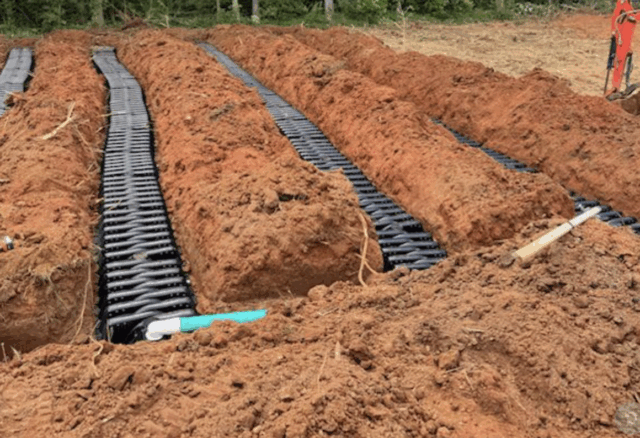 Conventional System:
This system requires no additional dirt to be brought into the area. The natural soil is suitable such that the field lines can be installed into the existing ground. This would be a score of a “9-10.”
Shallow Conventional:
This system is necessary when the soil is moderate. The field lines will be installed in the natural soil but will also require anywhere from 0 to 12 inches of soil added as cover. This would be a score of a “5-8.”
Engineered Onsite Sewage System (OSS)
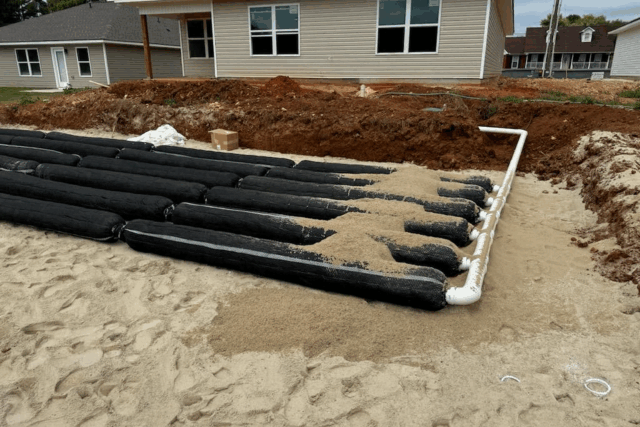 Required for restrictive soils, small lots, or steep slopes. Includes:
- Mound systems
- Sand Based Treatment Systems
- Advanced treatment units
Engineered designed septic systems are required when the natural soil cannot support field lines. In this case, a septic mound or other alternative must be installed in which to transfer the effluent to the ground. Unfortunately, this is worst case scenario, with a score of a “1-4.”
Almost all land in North Alabama can support a septic system - the difference is conventional vs. engineered.
| Factor |
Examples of Criteria for Engineered OSS (not all inclusive) |
|---|---|
| Lot Size | < 15,000 sq ft |
| Slope | > 25% in drain field |
| Soil |
Restrictive Layer or High Perc Rate |
| Flow | > 1,800 GPD |